The hum of wheels against tracks, the rhythmic clatter of carriages, the occasional screech of brakes—these are the sounds most travelers associate with train journeys. But what if rail travel could be nearly silent? Recent advancements in rail technology have ushered in a new era of ultra-quiet trains, with some models registering noise levels below 35 decibels—comparable to a whisper in a library. These "silent trains" are redefining comfort and sustainability in public transportation.
For decades, noise pollution from trains has been an unavoidable byproduct of rail systems. Traditional trains often operate at noise levels between 70 and 90 decibels, equivalent to the roar of a vacuum cleaner or busy city traffic. Prolonged exposure to such noise can contribute to stress, sleep disturbances, and even cardiovascular issues. The emergence of sub-35-decibel trains, however, promises to mitigate these concerns while offering an unprecedented level of tranquility for passengers.
How Silent Trains Achieve Near-Silence
The engineering behind these whisper-quiet trains is a marvel of modern acoustics. One key innovation lies in the wheel-and-rail interface. By using precision-machined wheels with noise-dampening materials and continuously welded rails that eliminate the "clickety-clack" of traditional joints, engineers have drastically reduced rolling noise. Some models even employ magnetic or air-cushion suspension systems that minimize mechanical contact altogether.
Another breakthrough comes from aerodynamic design. High-speed trains have long struggled with "tunnel boom," the deafening pressure wave created when entering confined spaces at velocity. Silent trains combat this with elongated noses and perforated panels that disrupt air turbulence. Combined with sound-absorbing insulation in carriage walls and double-glazed windows, these features create an environment where conversations needn't compete with ambient noise.
The Passenger Experience: Library-Quiet Journeys
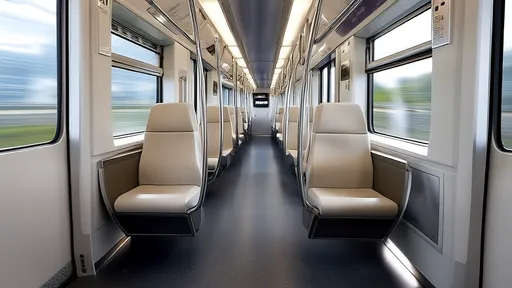
Board one of these next-generation trains, and the difference is immediately apparent. The absence of vibration and mechanical din allows passengers to hear subtle sounds previously drowned out—the rustle of a newspaper, the ping of a smartphone notification, even the quiet hum of the HVAC system. Business travelers report being able to concentrate on work without headphones, while parents appreciate that infants often sleep through entire journeys.
Perhaps most remarkably, the quietness enhances other sensory aspects of travel. With reduced auditory distraction, passengers become more aware of visual details—the landscape scrolling past windows takes on cinematic quality when unaccompanied by rattling. Some operators have even partnered with acousticians to design calming ambient soundscapes that complement the natural quiet, further elevating the travel experience.
Environmental Impact Beyond Passenger Comfort
While human benefits are significant, the ecological implications may be even more profound. Noise pollution doesn't just affect passengers—it disrupts wildlife habitats along rail corridors. Studies show that conventional train noise can alter animal communication patterns and migration routes. Silent trains could help preserve biodiversity, particularly in sensitive areas like wetlands or forests where rail lines often pass.
The technology also intersects with energy efficiency. Many silent train designs incorporate regenerative braking systems that recover kinetic energy, reducing power consumption. When combined with the aerodynamic improvements that lower air resistance, these trains frequently achieve 20-30% greater energy efficiency than conventional models—a sustainability win that compounds their acoustic benefits.
Challenges and Future Directions
Despite their promise, silent trains face hurdles. Retrofitting existing rail infrastructure to accommodate them requires substantial investment, as older tracks may need resurfacing to meet the precision requirements of whisper-quiet operation. There are also safety considerations—some regulators worry that extremely quiet trains could pose risks to track workers or pedestrians at crossings who rely on auditory cues.
Looking ahead, researchers are exploring even more radical solutions. One experimental prototype uses active noise cancellation technology adapted from premium headphones, deploying microphones and speakers throughout the train to generate inverse sound waves that neutralize noise in real time. Another team is developing "bio-inspired" surfaces that mimic owl feathers—nature's masters of silent flight—to further reduce aerodynamic noise.
As cities grow denser and environmental standards tighten, the demand for silent rail technology will likely accelerate. What began as a luxury feature may soon become an industry standard, transforming not just how we travel, but how we conceptualize public transportation's role in our sonic environment. The age of the silent train has arrived—and it's speaking volumes about the future of transit.

By /Jul 16, 2025

By /Jul 16, 2025

By /Jul 16, 2025

By /Jul 16, 2025

By /Jul 16, 2025

By /Jul 16, 2025

By /Jul 16, 2025

By /Jul 16, 2025

By /Jul 16, 2025
By /Jul 16, 2025

By /Jul 16, 2025

By /Jul 16, 2025

By /Jul 16, 2025

By /Jul 16, 2025

By /Jul 16, 2025

By /Jul 16, 2025

By /Jul 16, 2025

By /Jul 16, 2025

By /Jul 16, 2025

By /Jul 16, 2025
