The predawn hours on a working dairy or sheep station hold a particular magic that few outside the agricultural world ever witness. As most of the world still slumbers beneath star-flecked skies, temporary workers—those unsung heroes of predawn shifts—are already moving through the rhythmic rituals of milking and shearing. There’s a quiet spirituality to these tasks, a meditative quality that transforms manual labor into something resembling morning devotion.
For those unfamiliar with the life of a seasonal farmhand, the notion of "morning practice" might seem incongruous with the physical demands of livestock work. Yet ask any experienced dairy hand or shearer, and they’ll describe the almost ceremonial precision of their routines. The 3:30 AM alarm, the steaming breath in cold air as boots crunch across frost-laden grass, the first creak of the milking parlor door—these form the overture to a symphony of purposeful motion.
The Milky Way Before Dawn
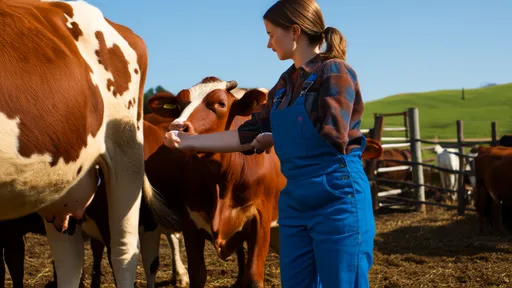
In the dairy barn, the process begins not with action but with observation. Seasoned milkers develop an intuitive connection with their charges, reading subtle signs in the way a cow shifts its weight or flicks its ears. The initial sanitizing of udders isn’t merely hygiene—it’s the first contact in a nonverbal conversation between human and animal. As warm milk begins to stream into pails, the sound changes from sporadic splashes to a steady hiss, creating an auditory rhythm as reliable as a metronome.
Modern rotary parlors with their mechanical efficiency can’t replicate the ancient knowledge passed down through generations of milkers. Temporary workers often learn the old techniques—the proper angle for hand-milking, the specific pressure needed to avoid discomfort, the way to position one’s body to prevent fatigue during hours of repetitive motion. There’s an art to maintaining focus when your hands work independently of conscious thought, when muscle memory takes over and the mind enters a state of flow.
Shearing as Moving Meditation
Over in the shearing shed, a different but equally profound discipline unfolds. Where milking is a study in patient stillness, shearing represents controlled motion. The best shearers move with economical precision, their blades tracing invisible patterns across woolly landscapes. Each sweep removes fleece in one continuous piece—a skill that looks effortless only because of countless predawn hours spent perfecting the craft.
The physicality of shearing belies its mental requirements. Like a martial artist executing kata or a calligrapher painting characters, the shearer must maintain perfect form despite fatigue. Back straight, knees bent, the worker becomes part of an unbroken lineage stretching back to antiquity. The smell of lanolin, the resistance of dense wool, the occasional protest from the sheep—all fade into the background as the rhythm takes over.
The Alchemy of Routine
What transforms these agricultural tasks into something approaching spiritual practice? The answer lies in their immutable daily nature. Unlike office jobs where each day brings novel problems, farm work follows celestial time. Cows demand milking with the same urgency whether it’s Christmas morning or harvest festival. Sheep grow wool indifferent to human calendars. This enforced regularity creates a framework within which mindfulness naturally arises.
Seasonal workers frequently report entering a state akin to meditation during these morning rituals. The combination of physical exertion, repetitive motion, and necessary presence (one can’t daydream while handling animals) produces an unexpected mental clarity. Many describe solutions to personal problems appearing unbidden during milking sessions or realizing answers to lingering questions mid-shear. The hands work, the body sweats, and the mind—finally freed from its usual chatter—finds space to breathe.
The Temporary Worker’s Perspective
There’s a particular wisdom among migrant agricultural laborers that urban professionals rarely encounter. These transient practitioners of ancient crafts move between farms like monastic orders might rotate between retreats. They carry techniques from one valley to the next, exchanging milking styles or shearing grips like philosophers trading sutras. Their morning practices remain constant even as landscapes change around them.
Perhaps the greatest lesson from these dawn rituals is the dignity found in mastery of humble tasks. In an era obsessed with disruption and innovation, the temporary farmhand demonstrates the power of perfecting fundamentals. A flawless milking technique developed over decades commands as much respect as any technological breakthrough. A shearer’s ability to "read" wool quality by touch alone constitutes a form of nonverbal intelligence our screen-dominated world has largely forgotten.
As sunlight finally crests over pasture hills, the morning’s work reaches completion. Buckets of fresh milk await pasteurization; bales of wool stand ready for grading. The temporary workers wipe their brows, stretch aching muscles, and prepare for daytime chores. Their morning practice—equal parts labor and liturgy—has once again woven human effort into nature’s enduring patterns. And tomorrow, before stars fade, they’ll begin again.

By /Jul 16, 2025

By /Jul 16, 2025

By /Jul 16, 2025

By /Jul 16, 2025

By /Jul 16, 2025

By /Jul 16, 2025
By /Jul 16, 2025

By /Jul 16, 2025

By /Jul 16, 2025

By /Jul 16, 2025

By /Jul 16, 2025

By /Jul 16, 2025

By /Jul 16, 2025

By /Jul 16, 2025

By /Jul 16, 2025
By /Jul 16, 2025

By /Jul 16, 2025

By /Jul 16, 2025

By /Jul 16, 2025

By /Jul 16, 2025
