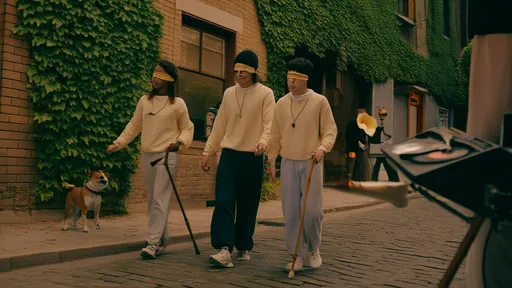
In the heart of the bustling city, a unique sensory adventure unfolds as participants of the "Blind Walk Experience Camp" navigate urban landscapes guided solely by smell and sound. This innovative program challenges conventional ways of interacting with our surroundings, offering a profound perspective on accessibility and perception.
The concept originated from a collaboration between urban designers and advocates for the visually impaired. By removing the dominant sense of sight, organizers aim to heighten awareness of how cities can be experienced differently. Participants describe the initial moments as disorienting yet strangely liberating, as the absence of visual stimuli forces them to reconstruct mental maps through alternative senses.
Morning sessions begin with sensory calibration exercises. Guides teach participants to distinguish between the sharp acidity of coffee beans versus the buttery richness of freshly baked croissants wafting from bakery doors. The crackle of tram cables overhead becomes a navigational beacon, while the rhythmic tapping of canes creates an acoustic topography of sidewalk boundaries.
Urban soundscapes reveal hidden patterns when analyzed through this experiential lens. The whoosh of revolving doors marks building entrances more reliably than any visual signage. Restaurant exhaust vents create thermal landmarks detectable from meters away. One participant recounted following the scent trail of a florist's discarded stems to navigate three blocks without assistance.
Architectural acoustics play a surprising role in wayfinding. Stone facades reflect sound differently than glass curtain walls, allowing participants to gauge building heights and street widths. The echo of footsteps changes timbre when passing alleyways, creating auditory shadows that signal potential turns. This phenomenon led designers to reconsider how urban materials influence non-visual navigation.
Midday brings the challenge of crowded spaces. Without visual cues, participants learn to interpret the Doppler effect of passing conversations to maintain directional awareness. The density of foot traffic becomes measurable through olfactory clues - the concentration of perfume molecules or the approach of food vendors. Some develop techniques like tracking the "wake" created by faster-moving pedestrians.
The experience profoundly impacts participants' understanding of urban design. Many report newfound appreciation for tactile paving and audible traffic signals typically overlooked by sighted individuals. Others critique how modern cities privilege visual aesthetics over multisensory functionality, noting the disappearance of aromatic landmarks like newsstand tobacco or bookstore paper in increasingly sanitized urban environments.
Afternoon sessions focus on memory and imagination. Without visual confirmation, mental images of spaces become fluid reconstructions. A participant described "seeing" a café terrace through the clatter of dishes and espresso machine hisses, only to discover upon removing their blindfold that the actual layout differed dramatically from their imagined version.
Organizers incorporate elements of sensory storytelling. Guides narrate architectural histories through sound - demonstrating how ironwork railings produce distinct metallic pings when tapped, or how different pavement materials reveal a neighborhood's historical layers. This approach transforms mundane urban features into rich sensory archives.
The program has sparked dialogue about inclusive design beyond ADA compliance. Participants frequently propose innovations like "scent trails" between transit hubs or standardized acoustic landmarks. Some urban planners attending the workshops now consider how zoning decisions affect olfactory wayfinding - noting that relocating fish markets or flower districts effectively erases traditional navigation routes for visually impaired residents.
As dusk falls, the experience intensifies. Nighttime brings out urban sounds often masked by daylight activity - the hum of electrical transformers, water moving through underground pipes, the creak of aging infrastructure. These become crucial orientation tools when visual references fade completely. Many report this as the most profound segment, revealing how darkness equalizes sensory perception.
Post-experience debriefs uncover unexpected insights. A graphic designer realized how visual-centric her profession remains after struggling to conceptualize information hierarchies without images. An architect reconsidered his reliance on renderings after experiencing how spatial qualities translate through sound and texture alone.
The program's lasting impact manifests in subtle but significant ways. Graduates report permanent changes in perception - automatically noting the scent profile of new neighborhoods or the acoustic properties of building materials. Some have initiated "sound walks" in their own communities, while others advocate for sensory considerations in urban planning meetings.
This immersive experience ultimately challenges participants to reconsider the hierarchy of senses in daily life. By demonstrating how thoroughly smell and hearing can map urban environments, the Blind Walk Experience Camp reveals both the limitations of visual dominance and the untapped potential of multisensory cities. As one participant summarized, "I didn't realize how much I wasn't hearing until I stopped seeing."
By /Jul 16, 2025
By /Jul 16, 2025

By /Jul 16, 2025

By /Jul 16, 2025

By /Jul 16, 2025
By /Jul 16, 2025
By /Jul 16, 2025

By /Jul 16, 2025
By /Jul 16, 2025
By /Jul 16, 2025

By /Jul 16, 2025

By /Jul 16, 2025
By /Jul 16, 2025
By /Jul 16, 2025
By /Jul 16, 2025

By /Jul 16, 2025
By /Jul 16, 2025
By /Jul 16, 2025
By /Jul 16, 2025

By /Jul 16, 2025
