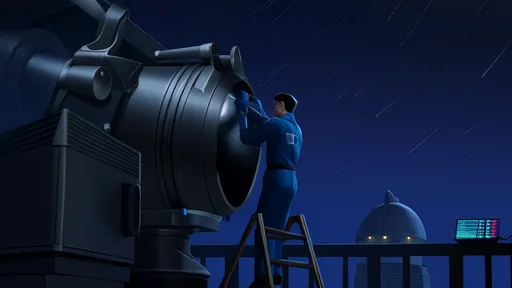
The quiet hum of the night envelops the observatory as the assistant astronomer adjusts the focus knob on the refractor telescope. A faint click echoes through the dome as the mechanism locks into place. Outside, the sky is a tapestry of stars, each one a distant sun waiting to be studied. Nights like these are both a privilege and a responsibility for those who tend to humanity’s windows to the cosmos.
Maintaining the instruments that reveal the universe is no small task. Telescopes, whether refractors or reflectors, demand meticulous care. Dust accumulates on lenses and mirrors, degrading image quality. Humidity can warp delicate components, and temperature fluctuations may misalign optical paths. The assistant’s nightly ritual begins with a soft brush to remove any particles from the primary lens, followed by a careful inspection of the mount’s gears. Even the slightest imperfection can distort observations, turning a crisp pinpoint of light into a blurred smudge.
Aligning the telescope is an art in itself. Polaris, the North Star, often serves as a reference point for calibration. The assistant checks the polar alignment, making minute adjustments to ensure the instrument tracks celestial objects with precision. A misaligned telescope might still show the stars, but capturing detailed images or tracking a comet’s path becomes impossible. The process is slow, methodical—a dance between patience and technical skill.
Recording the night sky is more than just pointing the telescope and taking notes. Every observation must be logged with exact timestamps, atmospheric conditions, and equipment settings. A faint nebula glimpsed through the eyepiece might hold clues about stellar formation, but without proper documentation, the data is useless. The assistant scribbles notes in a leather-bound journal, the pages filled with sketches of star clusters and hastily written coordinates. Later, these notes will be cross-referenced with digital logs, ensuring no detail is lost.
Some nights are reserved for routine maintenance, while others are dedicated to specific projects. A variable star might need monitoring over weeks, its brightness flickering like a distant candle. Or perhaps a newly discovered asteroid requires tracking to refine its orbit. The assistant works in tandem with astronomers, their efforts a silent but crucial part of the scientific process. There’s a quiet thrill in knowing that tonight’s observations could contribute to a future breakthrough.
The relationship between an assistant and their telescope is deeply personal. Each instrument has its quirks—a stubborn focuser, a mount that creaks when cold. Learning these idiosyncrasies takes time, but the bond ensures smoother nights and better data. The assistant knows when to nudge the focus just a hair more, or when to let the telescope settle after adjusting its position. It’s a partnership built on familiarity and trust.
Beyond maintenance and observation, there’s the intangible reward of witnessing the cosmos firsthand. Peering into the eyepiece, the assistant sees not just points of light, but distant worlds and ancient suns. The Andromeda Galaxy, a faint smudge to the naked eye, resolves into a swirling disk of stars. Saturn’s rings tilt into view, a sight that never grows old. These moments are reminders of why the work matters—not just for science, but for the soul.
Technology has transformed astronomy, yet some traditions endure. Digital sensors and automated mounts now handle tasks that once required manual labor, but the human element remains irreplaceable. An experienced eye can spot anomalies that algorithms might miss, and intuition often guides where to look next. The assistant balances old and new, wielding a smartphone app to check sky charts while still relying on handwritten logs for certain tasks.
As dawn approaches, the assistant prepares the telescope for shutdown. Dust covers are replaced, electronics powered down, and the dome rotated to shield the instrument from the rising sun. Another night’s work is complete, but the stars will return, and with them, another opportunity to explore the infinite. For the assistant astronomer, the night sky is both a workplace and a wonder—a realm where meticulous care meets boundless discovery.
By /Jul 16, 2025

By /Jul 16, 2025

By /Jul 16, 2025

By /Jul 16, 2025

By /Jul 16, 2025

By /Jul 16, 2025

By /Jul 16, 2025

By /Jul 16, 2025

By /Jul 16, 2025

By /Jul 16, 2025

By /Jul 16, 2025

By /Jul 16, 2025

By /Jul 16, 2025

By /Jul 16, 2025

By /Jul 16, 2025

By /Jul 16, 2025

By /Jul 16, 2025

By /Jul 16, 2025

By /Jul 16, 2025

By /Jul 16, 2025
