The relentless fury of typhoons has shaped architectural ingenuity across Asia’s coastal and mountainous regions, giving rise to structures that defy nature’s wrath. From the earthen fortresses of Fujian’s tulou to the low-slung stone houses of Okinawa’s Ishigaki Island, these buildings are not merely shelters but testaments to human resilience. Their designs, honed over centuries, reveal a profound understanding of wind dynamics, material science, and communal living—principles that modern engineers still study today.
The Fujian Tulou: Communal Strongholds Against the Storm
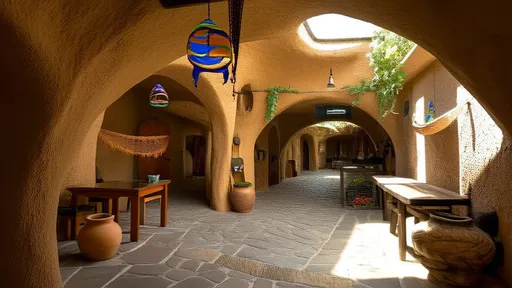
Nestled in the misty highlands of southeastern China, the Fujian tulou stand as colossal sentinels against typhoons. These circular or rectangular earthen buildings, some towering five stories high, were constructed by the Hakka people between the 12th and 20th centuries. Their thick walls—a composite of rammed earth, bamboo, and lime—absorb and dissipate wind forces, while the overhanging tiled roofs shield the interior from driving rain. What’s remarkable is their aerodynamic shape: circular tulou, like the Chengqi Lou with its 62 concentric rooms, channel winds around their curves, reducing structural stress. The communal layout, housing up to 800 residents, ensured collective survival during prolonged storms.
Beyond their physical robustness, tulou embody a social architecture. Central courtyards became storm-proof spaces for livestock and crops, while the wooden internal frameworks allowed flexibility during earthquakes—a frequent companion to typhoons in this seismic zone. UNESCO recognized this symbiosis of form and function in 2008, declaring the tulou a World Heritage Site. Today, engineers dissect their passive cooling systems and gravity-defying weight distribution, seeking clues for sustainable housing in hurricane-prone areas.
Okinawa’s Ishigaki Houses: The Art of Low-Profile Defense
Some 1,200 kilometers east, the subtropical islands of Okinawa developed a contrasting yet equally effective typhoon-resistant architecture. Here, the traditional Ishigaki house hugs the ground like a crouching tiger. Its defining feature? Walls of coral limestone blocks, mortared with crushed shells and clay, weighing down the structure against 250 km/h winds. Unlike the vertical tulou, these single-story dwellings sprawl horizontally, their roofs angled at precisely 30 degrees to minimize wind uplift—a geometry later adopted by Japanese modernist architects.
The genius lies in the details. Lattice-covered windows (called jimaki) break incoming gusts into manageable streams, while the hinpun—a front-yard stone screen—acts as a wind baffle. Roofs are anchored not with nails but with woven vines that tighten under tension, allowing the structure to flex without collapsing. Locals still recount how during 1971’s Typhoon Olive, while concrete buildings crumbled, Ishigaki homes lost only roof tiles—a vindication of ancestral wisdom. Contemporary builders now integrate these principles into typhoon-proof resorts across the Ryukyu Islands.
Material Alchemy: From Earth to Coral
The material choices in these regions reflect a deep dialogue with local geology. Fujian’s tulou use laterite soil rich in iron oxide, which hardens like concrete when compacted, while Okinawa’s coral limestone provides natural salinity that repels termites—a silent threat during post-typhoon rebuilding. Both architectures employ thermal mass principles: the tulou’s 1.8-meter-thick walls regulate indoor temperatures year-round, and Ishigaki’s stone floors stay cool even in humid summers. This duality of storm resistance and climate adaptability sets them apart from Western bunker-style designs.
Modern material scientists have discovered that the tulou’s lime-honey-eggwhite mortar has self-healing properties, filling micro-cracks during rainfall. Similarly, Okinawa’s shell-based mortar exhibits surprising tensile strength due to organic fibers. These findings have spurred biomimetic material research, with teams from Kyoto to California developing "living concretes" infused with bacteria that mimic these ancient formulas.
The Human Element: Culture Embedded in Walls
These structures are more than typhoon shields—they’re cultural vaults. Every tulou doorway is aligned using feng shui principles to channel beneficial qi while deflecting malignant winds, and their concentric layouts mirror Confucian clan hierarchies. Okinawan homes feature hinukan hearths aligned to spiritual wind directions, with kitchen gardens positioned in the lee of stone walls. The very act of communal post-typhoon repairs strengthened social bonds, a practice now fading with modern individualism.
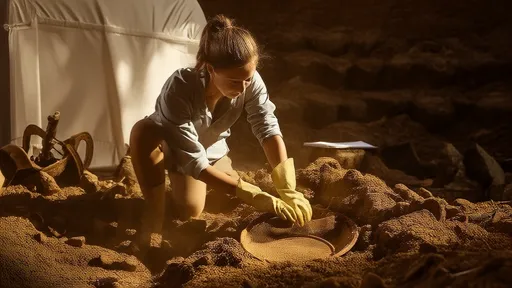
This erosion of traditional knowledge worries preservationists. When Super Typhoon Haishen battered Okinawa in 2020, younger residents relying on concrete apartments faced prolonged power outages, while elderly in restored Ishigaki homes stayed safe with their passive ventilation and rainwater collection systems. NGOs now work with UNESCO to document oral construction techniques before master builders—many in their 80s—disappear.
Legacy in Modern Disaster Architecture
The influence of these ancient designs permeates contemporary typhoon-resistant architecture. Shanghai’s Pingtan International Art Museum incorporates tulou-inspired circular windbreakers, while Okinawa’s new evacuation centers use Ishigaki-style stone lattices for ventilation during power failures. Perhaps the most poignant adaptation is in the Philippines, where post-Haiyan rebuilding projects fused tulou layouts with local materials, creating hybrid shelters that withstood 2021’s Typhoon Rai.
As climate change intensifies Pacific typhoons, these historical blueprints offer more than nostalgia—they provide actionable intelligence. The next frontier may lie in smart materials that replicate the tulou’s dynamic load distribution or AI-optimized versions of the Ishigaki roof angle. But as architects digitize these forms, the enduring lesson remains: the best defense against nature’s fury isn’t brute strength, but adaptive wisdom carved in earth and stone.

By /Jul 16, 2025
By /Jul 16, 2025

By /Jul 16, 2025

By /Jul 16, 2025

By /Jul 16, 2025

By /Jul 16, 2025
By /Jul 16, 2025

By /Jul 16, 2025

By /Jul 16, 2025
By /Jul 16, 2025

By /Jul 16, 2025
By /Jul 16, 2025

By /Jul 16, 2025

By /Jul 16, 2025

By /Jul 16, 2025

By /Jul 16, 2025
By /Jul 16, 2025

By /Jul 16, 2025

By /Jul 16, 2025

By /Jul 16, 2025
