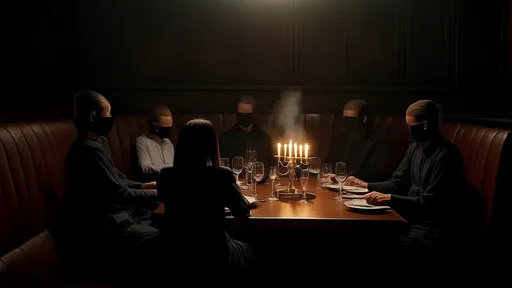
In a world where dining experiences often prioritize visual presentation, a growing movement challenges guests to engage their other senses by removing sight entirely. Dark dining restaurants have emerged as avant-garde establishments where patrons eat in complete darkness, served by visually impaired waitstaff who navigate the pitch-black environment with ease. These unique venues transform meals into multisensory adventures, amplifying taste, smell, and texture while stripping away the visual biases that shape our relationship with food.
The concept originated in 1999 when a blind pastor named Jorge Spielmann experimented with blindfolded dinners in Zurich to help sighted guests understand disability. Today, permanent dark restaurants operate globally from London to Beijing, their windowless interiors sealed against even faint light leaks. Upon arrival, diners surrender phones, light-emitting watches, and other glow-producing items before being guided to their tables through light-lock corridors that gradually acclimatize them to absolute blackness.
Without visual cues, ordinary ingredients become mysterious puzzles. A simple cherry tomato might initially register as unfamiliar until its burst of acidity floods the palate with recognition. Textures grow more pronounced - the silkiness of a mushroom duxelles contrasts sharply with crispy phyllo pastry layers. Even temperatures seem more extreme when unseen; a chilled gazpacho shot creates greater surprise than when anticipated by its appearance.
Menus remain secret until after the meal to prevent preconceptions. One London dark restaurant's signature dish - later revealed as duck breast with blackberry reduction - frequently gets mistaken for venison or even exotic meats. This sensory confusion demonstrates how heavily we rely on vision to identify flavors, with studies showing diners struggle to recognize even familiar foods like coffee or carrots in darkness.
The experience reshapes social dynamics as well. Lacking the ability to monitor others' reactions through body language or facial expressions, conversations become more intimate and focused. Invisible strangers at neighboring tables might join discussions freely, their disembodied voices floating through the dark. Laughter rings louder when unseen, and the clinking of silverware takes on new significance as the primary indicator of others' dining progress.
Service in these establishments requires specialized training. Waitstaff develop remarkable spatial memory, navigating between tables while balancing trays entirely through touch and sound cues. Many are visually impaired professionals whose abilities shine in this environment. Their expertise extends to anticipating needs - replacing dropped cutlery before guests realize it's missing, or describing wine aromas with poetic precision to compensate for the missing visual component of swirling and observing legs.
The psychological effects prove as fascinating as the culinary ones. First-time diners often report initial anxiety giving way to profound relaxation as their brains reallocate visual processing power to other senses. Some experience mild hallucinations - seeing phantom lights or colors that don't exist - as the visual cortex searches for stimulation. Regular patrons describe developing "dark dining legs," much like sea legs, where subsequent visits feel progressively more natural.
Chefs designing menus for these venues face unique challenges. Presentation plating disappears as a consideration, replaced by meticulous attention to contrasting textures and temperature variations that guide the diner's experience. Strategic use of aromatic herbs and edible flowers enhances navigation through scent trails. One New York dark kitchen intentionally crafts dishes with multiple components to encourage tactile exploration, like hiding a quail egg inside a mushroom cap or suspending scallops in a seaweed nest.
Beyond novelty, these restaurants serve important social functions. Many operate as social enterprises employing visually impaired staff at competitive wages while raising awareness about disability. Some incorporate blindfolded workshops where corporate teams build empathy through simulated visual impairment exercises. The venues also provide rare public spaces where blindness confers advantage, flipping traditional ability hierarchies.
The darkness reveals unexpected truths about human perception. Regulars report lasting changes in how they eat even in lighted environments - chewing more slowly, noticing subtle flavors previously overwhelmed by visual stimuli. Some find themselves preferring certain foods in darkness that they typically avoid when seen, confronting unconscious biases about color or appearance. As one Berlin dark restaurant owner observes: "When you can't judge a sauce by its color, you finally taste it for what it really is."
These establishments continue evolving beyond their initial gimmick status. High-end dark tasting menus now pair courses with curated soundscapes - crunching autumn leaves audio accompanying forest-foraged dishes, or ocean waves with seafood selections. A Tokyo pop-up recently experimented with scent-only amuse-bouches served before entering the dining room. Meanwhile, researchers collaborate with dark restaurants to study cross-modal perception, gathering data on how humans process flavor without visual interference.
For adventurous diners, the experience offers more than just a meal. It's a neurological journey that recalibrates the senses, a social experiment that redefines interaction, and a culinary revelation that challenges everything we assume about taste. As the trend spreads globally, these lightless venues illuminate surprising truths about how we perceive - and prejudice - the world through our eyes.

By /Jul 16, 2025

By /Jul 16, 2025

By /Jul 16, 2025

By /Jul 16, 2025

By /Jul 16, 2025

By /Jul 16, 2025

By /Jul 16, 2025

By /Jul 16, 2025

By /Jul 16, 2025

By /Jul 16, 2025

By /Jul 16, 2025

By /Jul 16, 2025

By /Jul 16, 2025

By /Jul 16, 2025

By /Jul 16, 2025

By /Jul 16, 2025

By /Jul 16, 2025
By /Jul 16, 2025

By /Jul 16, 2025

By /Jul 16, 2025
